

Author: Austin Stanfel
Playgrounds are more than swings and slides to keep kids entertained; they offer a perfect space for the initial learning of a child. The type of activities on a playground is one of the most imperative aspects of a child’s development. Playgrounds are critical to the mental and physical development of children.
Playgrounds allow children to practice social, psychological, physiological, and intellectual skills. You can boost the value of play by understanding the benefits of adding stimulating and challenging playground equipment to your playground.
Why Are Age-Appropriate Playgrounds Necessary?
It is vital to utilize playgrounds according to age. There should be an indication of age-appropriate areas to be placed in these areas. Be considerate while purchasing playground equipment. Try to make play areas more developmentally appropriate, enjoyable, and safe for children.
We often misunderstand the term age-appropriate play just for babies and toddlers; however, it should be designed to engage children of all ages. Many playset manufacturers scale down a large playset and label it preschool-size or infant-age-appropriate. A good designer will consider safety guidelines, anthropomorphic data, and each age group’s cognitive and physical abilities when designing an age-appropriate playground.
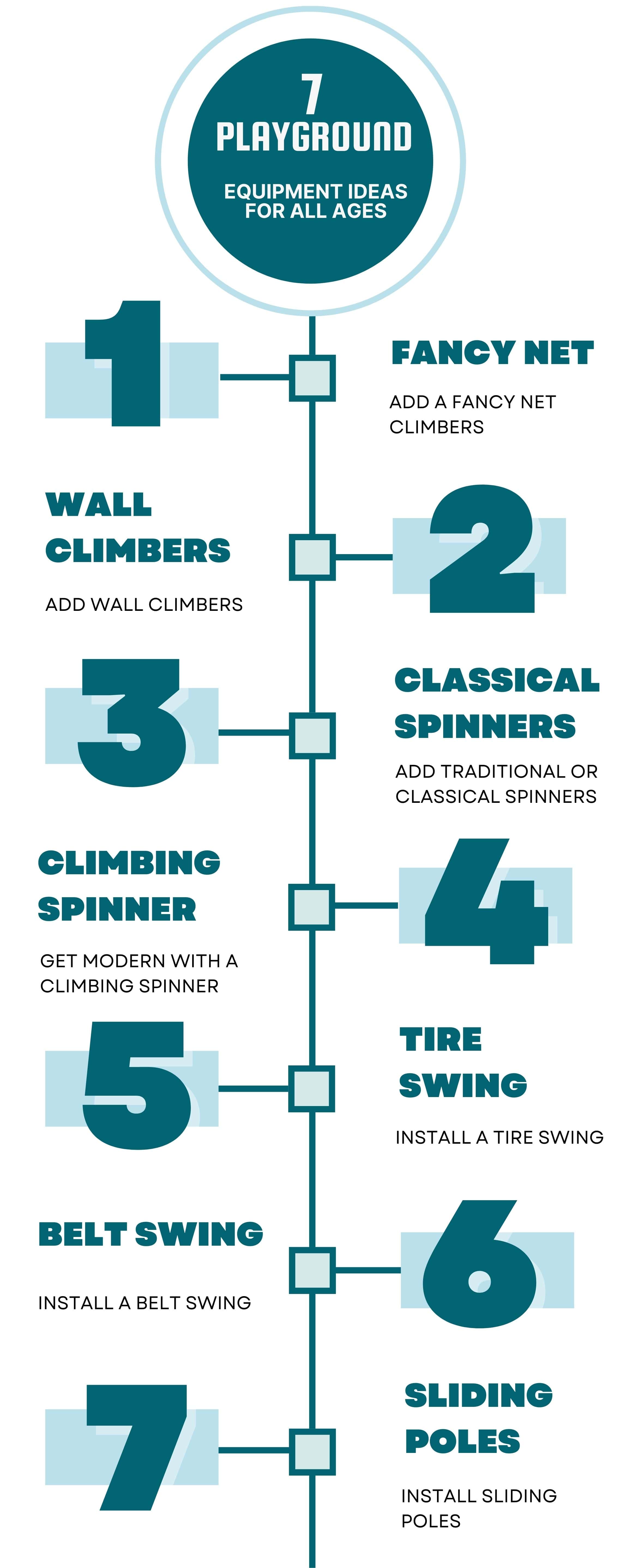
7 Ideas Age Appropriate Equipment Ideas For Playgrounds
Here are seven pieces of age-appropriate playground equipment that are a must-have at your playground.
1. Add A Fancy Net Climbers
Climbing equipment allows children to use their limbs and coordination skills to move from one end or side of a climber to the other. Climbing can help children develop confidence and muscle strength in their movements and fine motor skills. A child starts using their fine motor skills to grasp handles, rungs, or other structural components to propel themselves above or below when trying to climb.
Moreover, net climbers offer a pleasurable experience for youngsters learning to think critically, which will assist them in ascending and descending the structure. Net climbers can also help with directional and spatial awareness to keep all school-age children engaged.
2. Add Wall Climbers
Wall climbers are another option for designing an age-appropriate playground. The first thing that a child notice after entering a playground is probably a wall climber. Wall walkers are an eye-catching, exciting way for kids to practice their climbing skills.
The wall climbing structures allow children to use proprioceptive skills to plan their movements as they climb across, up, and down. Wall climbers are also cost-effective equipment and can be used by pre-schoolers and early teenagers.
3. Add Traditional Or Classical Spinners
Playground spinners, also known as carousels and merry-go-rounds, provide a thrilling experience for children. The traditional playground spinner is a piece of equipment that teaches children about motion and rhythm in their environment in a fun and cooperative way.
Traditional spinners can accommodate multiple children simultaneously, providing ample room for them to stand, kneel, or sit while spinning. Classic spinners have handles children can grasp while engaging in sensory play and movement.
4. Get Modern With A Climbing Spinner
Climbing spinners can focus on teaching proper body posture while twisting. It is fantastic because multiple children can still use the spinner simultaneously and enjoy this activity next to each other. It increases access to social engagement.
The climbing spinners are like the traditional ones. Nevertheless, they allow you to climb the structure while spinning for an exciting and challenging experience. These spinners teach children about their body’s perception and how it relates to gravity, movement, and balance.
5. Install A Tire Swing
Swings are an obvious inclusion to any community playground and are loved by children. Swing sets aid in the development of gross motor skills in children, such as pumping their legs and using their core for balance.
A tire swing, for example, allows children to work together to propel themselves forward and backward. A tire swing can also aid children in developing their cognition, muscle control, syncopation, and start concentration. It is excellent equipment for teaching children how to share and promote social interaction.
6. Install A Belt Swing
The U-shaped belt on these swings gives them a more traditional appearance. These are great for interactive and social play with others as children take turns swinging or swinging next to each other.
Belt swings are an exciting activity for kids because they allow them to soar high in the air while learning to control their body’s movement and balance. A U-shaped belt on these swings gives them a more traditional appearance.
These are great for interactive and social play with others as children take turns swinging or swinging next to each other. Belt swings are an exciting activity for kids because they allow them to soar high in the air while learning to control their body’s movement and balance.
7. Install Sliding Poles
Sliding poles are a new addition to modern-day playgrounds. They are not just a fun way to slide from one place to another through a slippery panel but are age-appropriate. Children develop a strong sense of grabbing things when they grasp the pole. It is an effective way to improve children’s physical strength.
Some kids are fond of high-speed excitement or thrilling rides, and sliding poles are ideal. Sliding poles are fast and exciting, which is why it has become the most loved item in playgrounds. Moreover, it encourages a sense of accepting challenges and overcoming them.
When children see other age fellows climbing and sliding around, they take it as a self-challenge to overcome obstacles. If you wish to create a sense of healthy balance in your little one, then it is time that you let them slide down through a sliding pole.
Wrapping Thoughts
Playgrounds are fun spaces; if we build them in an age-appropriate way, they can also become a safe space for our young ones. Age-appropriate equipment is available in the market and can easily be installed in the community and school playgrounds.
While designing a playground, creating separate sections for various age groups will be helpful. This way, everyone can have unlimited fun and thrill!