

Tag Archives: Play-Based Learning

Author: Austin Stanfel

The line between play and learning has always been a subject of interest and debate among educators, parents, and researchers. Some see play as a mere break from formal education, a time for children to unwind and relax. Others, however, recognize that play is a powerful learning tool that fosters creativity, problem-solving skills, and social development. In recent years, there has been a growing realization that there are no borders between play and learning. Instead, these two concepts are intertwined, with play as a fundamental vehicle for knowledge acquisition in young minds. This article will explore the idea that play and learning are inseparable, examining the benefits of playful education, its impact on children’s cognitive and social development, and practical ways to incorporate play into educational settings.

The Nature of Play

To understand the relationship between play and learning, it is essential to define what we mean by “play.” Play is a spontaneous and voluntary activity that is intrinsically motivated. It is characterized by enjoyment, exploration, and engagement with the task. Play can take many forms, including physical, imaginative, and cooperative. It can involve games, puzzles, art, storytelling, and pretend play.

Play also serves different functions in a child’s development. It is a means of self-expression, building social bonds, and a mechanism for developing cognitive and motor skills. These multifaceted aspects of play make it a rich and versatile tool for learning.

The Power of Play in Learning

1. Cognitive Development

Play engages children’s minds in ways that traditional learning environments often cannot. When children play, they are actively exploring their world, testing hypotheses, and solving problems. For example, a child playing with building blocks learns about balance, stability, and spatial relationships. They may not consciously realize it but are developing critical mathematical and engineering concepts through play.

2. Creativity and Imagination

Play is a breeding ground for creativity and imagination. When children engage in imaginative play, such as pretending to be characters in a story or inventing games, they exercise their creative muscles. These activities foster divergent thinking, which is crucial for problem-solving and innovation.

3. Emotional Regulation

Play helps children learn to manage their emotions. Through play, they can experiment with different emotional scenarios, like handling conflict in a pretend game or dealing with disappointment in a make-believe situation. This emotional rehearsal can teach children how to handle real-life situations more effectively.

4. Social Skills

Play is a social activity. Children who play together learn essential social skills like cooperation, negotiation, communication, and empathy. They practice taking turns, sharing, and resolving conflicts, all of which are vital for healthy relationships in adulthood.

5. Language Development

Play often involves storytelling and conversation, which are critical for language development. Children constantly develop their language skills through play, whether playing with dolls, creating dialogue, or building a story around toy animals.

The Integration of Play and Learning in Early Childhood Education

Recognizing the symbiotic relationship between play and learning, many early childhood education programs and schools have integrated play-based approaches into their curricula. Here are some critical elements of how play and learning are combined effectively in educational settings:

1. Play-Based Learning Environments

Early childhood classrooms are designed to encourage play. They include spaces and materials facilitating imaginative play, such as dress-up corners, building blocks, art stations, and reading nooks. These environments are carefully curated to promote exploration and creativity.

2. Scaffolding Play

Educators often participate in children’s play, known as scaffolding. They guide children’s play experiences by asking open-ended questions, providing information, and extending their learning. For instance, a teacher might ask a child building with blocks, “What do you think will happen if you put that block on top of the tower?”

3. Incorporating Educational Goals

Play-based learning is not aimless. Educators align play activities with specific educational goals. For example, if the objective is to teach math concepts, educators might introduce counting and sorting activities using toys or manipulatives.

4. Assessment Through Play

Assessment in play-based learning is often done through observation rather than traditional testing. Educators observe children’s interactions, problem-solving abilities, and language development during play to gauge their progress.

5. Flexible Curriculum

Play-based learning allows for flexibility in the curriculum. If children are interested in a topic or theme during play, educators can adapt the curriculum to explore that interest further, promoting a child-led approach to learning.

Challenges and Criticisms

While integrating play and learning in early childhood education has numerous benefits, it has challenges and criticisms. Some common concerns include:

1. Accountability and Standardized Testing

The emphasis on standardized testing in education can create pressure to abandon play-based approaches in favour of more structured, test-focused methods. Critics argue that this narrows the curriculum and reduces children’s holistic development.

2. Perceived Lack of Rigor

Some parents and educators worry that play-based learning may provide a different academic rigour than traditional teaching methods. However, research has shown that play-based approaches can lead to strong academic outcomes, especially in the early years.

3. Limited Resources

Creating and maintaining play-based learning environments can be resource-intensive. Not all schools and early childhood programs have the funding or facilities to support such approaches fully.

4. Teacher Training

Educators need specialized training to implement play-based learning strategies effectively. Not all teachers may have access to this training, leading to inconsistencies in the quality of play-based education.

Benefits of Play-Based Learning in Primary Education

The benefits of play-based learning extend beyond early childhood education. Many educators and researchers argue that play-based approaches can also be valuable in primary education. Here are some advantages of incorporating play into primary education:

1. Engagement and Motivation

Play-based learning can maintain children’s enthusiasm for learning. It makes education enjoyable and engaging, reducing the risk of disengagement and boredom.

2. Holistic Development

Play-based learning supports the holistic development of children, addressing not only academic skills but also social, emotional, and physical development.

3. Problem-Solving Skills

Play-based learning encourages critical thinking and problem-solving skills. Children learn to approach challenges with creativity and resilience.

4. Long-term Retention

Research suggests that knowledge acquired through play-based learning is often better retained because it is rooted in real-life experiences and practical applications.

4. Preparation for the Future

In a rapidly changing world, adaptability, creativity, and problem-solving skills are highly valued. Play-based learning helps children develop these skills, preparing them for future challenges.

Practical Ways to Incorporate Play into Education

Educators and parents can take several practical steps to incorporate play into education effectively:

1. Create Playful Environments

Ensure that learning spaces are designed to promote play. Provide a variety of materials and tools that encourage exploration and creativity.

2. Balance Structure and Freedom

Strike between structured learning and unstructured playtime. Allow children to choose their activities and interests while still introducing educational goals.

3. Use Play as Assessment

Incorporate observations of play into assessment methods. Assess children’s problem-solving abilities, creativity, and social interactions during play.

4. Professional Development

Invest in teacher training to help educators understand the value of play-based learning and develop the skills to implement it effectively.

5. Involve Parents

Encourage parents to support play-based learning at home by guiding age-appropriate activities and the importance of play in their child’s development.

6. Advocate for Policy Changes

Advocate for policies that support play-based learning in schools and early childhood programs. This includes funding for play-based materials and resources.

Conclusion

The notion that there are no borders between play and learning is a paradigm shift in education. Playful education recognizes children’s innate curiosity and drive for exploration and harnesses these qualities to facilitate learning. From cognitive development to social skills and emotional regulation, the play has the power to shape young minds in multifaceted ways.

While integrating play and learning in education faces challenges and criticisms, the benefits are undeniable. Play-based learning environments engage and motivate students, foster creativity, and prepare them for a rapidly changing world. As educators and parents, we must embrace the idea that play is not a break from learning but a vital component of it, helping children become well-rounded individuals ready to tackle future challenges. In this borderless realm of play and learning, the possibilities for education are boundless, and the potential for young minds is limitless.
Author:Austin Stanfel

For generations, the traditional classroom setup has been the go-to model for teaching and learning. This model typically involves a teacher lecturing at the front of the classroom while students sit passively in their seats, taking notes and listening attentively. While this model has been effective in some ways, it has also been criticized for needing to be more flexible and conducive to creative thinking and problem-solving.

In recent years, there has been a growing movement towards play-based learning, where students are given more opportunities to engage in hands-on, experiential learning activities. This approach has been shown to have many benefits, including increased engagement and motivation, improved social and emotional skills, and better academic outcomes.

Play-based learning can take many forms, from role-playing and games to building and creating. The key is that students are actively engaged in the learning process rather than simply being passive recipients of information. By incorporating play into the classroom, teachers can create a more dynamic and interactive learning environment that encourages students to explore, experiment, and collaborate.

One example of play-based learning is the use of games and simulations. Games can teach a wide range of subjects, from math and science to history and literature. For example, a math game might challenge students to solve a series of puzzles or problems, while a history game might ask them to take on the role of a historical figure and make decisions based on the historical context.

Simulations can also be a powerful tool for learning. For example, a science teacher might use a simulation to teach students about the properties of different materials, while a social studies teacher might use a simulation to help students understand the complexities of international diplomacy. Simulations can provide a safe and controlled environment for students to explore complex topics, allowing them to make mistakes and learn from them without real-world consequences.

Another example of play-based learning is the use of project-based learning. In project-based learning, students work on a long-term project that requires them to apply their knowledge and skills to a real-world problem or challenge. This approach can be highly engaging, as students are allowed to work on something meaningful and relevant to their lives.

For example, a science class might work on a project to design and build a solar-powered car, while a social studies class might work on a project to study the impact of immigration on local communities. Project-based learning can help students develop essential skills such as critical thinking, problem-solving, and collaboration while fostering creativity and innovation.

Finally, play-based learning can also involve creative expression and the arts. Students can explore their ideas and emotions by engaging in creative activities such as drawing, painting, and music while developing essential skills such as self-expression and communication.

For example, a language arts class might ask students to write and perform their plays, while a music class might ask students to compose their songs. These types of activities can be highly engaging and motivating, as students are allowed to express themselves in a creative and meaningful way.

While play-based learning can be highly effective, it has challenges. One of the biggest challenges is ensuring that the learning remains focused and purposeful. Teachers must design activities aligned with learning goals that allow students to apply their knowledge and skills meaningfully.

Another challenge is ensuring all students can participate fully in the learning activities. Students with disabilities or special needs may require additional support or accommodations to engage in play-based learning activities fully. Teachers must be mindful of these needs and work to ensure that all students can participate and succeed.

Despite these challenges, the benefits of play-based learning are clear. By incorporating play into the classroom, teachers can create a more engaging and dynamic learning environment that encourages creativity, innovation, and collaboration.

In addition, play-based learning has been shown to affect student motivation, engagement, and academic performance positively.
Research has shown that play-based learning can help students develop essential social and emotional skills such as empathy, self-regulation, and teamwork. These skills are essential for success in life, both in and out of the classroom. Teachers can help students develop these skills in a safe and supportive environment by providing opportunities to engage in play-based learning activities.

Furthermore, play-based learning can be particularly effective for students who struggle with traditional classroom methods. Students who have difficulty sitting still and focusing for extended periods may thrive in a play-based learning environment, where they can engage in hands-on activities that keep them interested and motivated.

Incorporating play-based learning into the classroom does not mean abandoning traditional teaching methods entirely. Instead, it means finding a balance between the two approaches. Teachers can still provide direct instruction and lectures when appropriate, but they can also incorporate play-based activities into their lessons to make the learning experience more engaging and interactive.

Teachers must be willing to take risks and experiment with new teaching methods to implement play-based learning effectively. This can be challenging, as it requires stepping outside of one’s comfort zone and trying new approaches to teaching. However, the benefits of play-based learning are well worth the effort.

To get started with play-based learning, teachers can begin by incorporating simple games and activities into their lessons. For example, a math teacher might ask students to work in pairs to solve a series of puzzles or riddles. A social studies teacher might ask students to role-play a historical event or debate a current issue. These activities can be highly engaging and help students develop essential skills such as critical thinking, problem-solving, and communication.

Teachers can also incorporate technology into play-based learning activities. Many educational apps and websites provide interactive and engaging learning experiences for students. For example, a science teacher might use a virtual lab to allow students to conduct experiments in a safe and controlled environment, while a language arts teacher might use an online platform to facilitate collaborative writing activities.

In addition to the benefits mentioned above, play-based learning can foster a love of learning in students. Students engaged in play-based learning activities are likelier to be excited and enthusiastic about learning. This can lead to a positive feedback loop, where students are motivated to learn more and more and are more likely to retain what they have learned.

Another benefit of play-based learning is that it can be customized to meet the needs of individual students. For example, teachers can provide play-based activities to accommodate different learning styles or skill levels. Students who are more visual learners may benefit from activities that involve drawing or creating visual representations of concepts, while students who are more kinesthetic learners may benefit from activities that involve movement or physical activity.

Play-based learning can also help students develop critical problem-solving skills. Students who engage in hands-on, experiential learning activities must think critically and creatively to solve problems. This can help them develop critical problem-solving skills that they can apply in various contexts.

Finally, play-based learning can help students develop a sense of ownership and autonomy over their learning. When students are engaged in play-based activities, they are more likely to take ownership of their learning and feel empowered to take control of their education. This can help them develop a sense of autonomy and self-direction that can be valuable in all areas of life.

Despite the many benefits of play-based learning, some educators and parents may hesitate to embrace it. One concern is that play-based learning may need to be more rigorous to prepare students for college and the workforce demands. However, research has shown that play-based learning can be as effective as traditional teaching methods in promoting academic achievement.

Another concern is that play-based learning may be too unstructured or chaotic, leading to a lack of discipline and order in the classroom. However, this can be mitigated by setting clear expectations and boundaries for students and incorporating play-based activities in a structured and intentional way.

Play-based learning is a powerful tool for engaging students and promoting learning. By incorporating play into the classroom, teachers can create a more dynamic and interactive learning environment that encourages creativity, innovation, and collaboration. While there are challenges to implementing play-based learning, the benefits are clear. Teachers can help students develop the skills they need to succeed in school and life by providing them with opportunities to engage in hands-on, experiential learning activities.

Author: Austin Stanfel

Have you thought of ways play-based learning is helping your child? Most parents are unaware of how much play-based learning offers in their kids’ lives and count it as time; today’s blog post aims to educate people on this mindset and let them know how they are making their kids miss out on a lot and how they can make the most of this time. Let us dig in.

What Is Play-Based Learning?

Play-based learning, also known as learning through play, is a psychological and educational approach focusing on how kids can learn while playing Psychologists now believe that through play, children can learn while playing, and even more so. We will talk about different aspects of the play-based approach to learning in detail, so stay connected.

Play-Based Learning Theory As A Teaching Approach

Play-based learning as an approach involves knowledge backed up by both teacher-supported aspects and children-initiated understanding. Teachers engage the children in various activities and inquire them in different ways for interaction, which leads to more thoughts and better thinking, which equals better learning for kids.

It is based not only on children’s interactions with teachers but also with other children. Peer interaction plays its part too. Kids play together, learn, discuss ideas, manage their problems, and many more, which is all a part of their learning.

What Are A Few Characteristics Of Play-Based Learning?

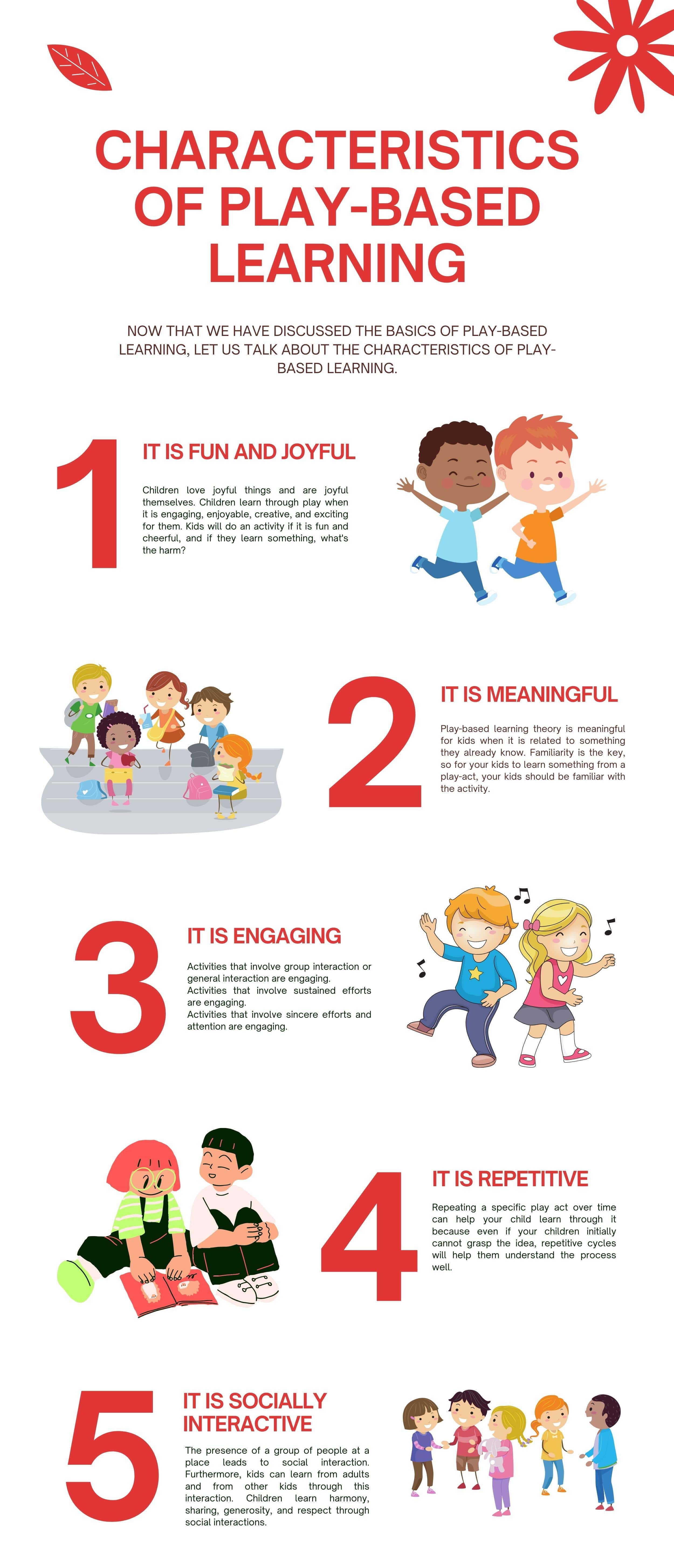
Now that we have discussed the basics of play-based learning, let us talk about the characteristics of play-based learning.

1. It Is Fun And Joyful

Kids are joyful and love things that are joyful too. So, kids learn through play when they find the play engaging, fun, creative, and exciting. If kids see a fun and cheerful activity, they will do it happily, and if they learn something in the process, where is the loss?

Keep a more accessible difficulty level average, which is relatively easy. Making it more accessible will make your child focus on accomplishing the task, and they will not enjoy learning something. On the other hand, your children may end up losing interest if the job is too easy enough. So maintain a neutral level.

2. It Is Meaningful

Play-based learning theory is meaningful for kids when it is related to something they already know. Familiarity is the key, so for your kids to learn something from a play-act, your kids should be familiar with the activity. To make a play/activity meaningful for kids, you can:

  • Connect it to some words or concepts your kids learned in school.
  • Connect it to a memorable event of your child, either in the family, with friends, or even at school.
  • Connect it to some favorite cartoon character of your kid or their favorite actor or anyone they love.

3. It Is Engaging

Any play-based activity you choose for your kids should be actively engaging. What are some things you should keep in mind? Let us tell you.

  • Activities that involve group interaction or general interaction are engaging.
  • Activities that involve sustained efforts are engaging.
  • Activities that involve sincere efforts and attention are engaging

4. It Is Repetitive

Repeating a specific play act over time can help your child learn through it because even if your children initially cannot grasp the idea, repetitive cycles will help them understand the process well. Now, how do you make your kids keep coming back?

The key to making them keep kids coming is to keep the play interesting. Innovation drives kids to be creative, and this creativity will keep kids coming back. Kids make mistakes, so they keep repeating them until they are good at them. Play-based learning works, keeping your kids hooked.

5. It Is Socially Interactive

It is a given that social interaction arises when a group of people is present at a place. Moreover, this interaction between kids and adults and between kids and other kids opens new ways of learning. Social interactions teach kids the values of harmony, sharing, generosity, and respect.

Kids learn how to function as an individual. They learn how to tackle various situations and how to overcome hurdles. A feeling of mutual interest drives this relationship and takes them a long way. A sense of challenge also motivates kids to do their best.

What Is An Example Of Play-Based Learning?

If things still need to be clarified, let us discuss it with an example so you can better understand the topic. For instance, building blocks is a famous game for kids because it has room for creativity. Consider a kid adding one block to a layer of three already present together in a line.

Now the teacher can relate this play to learning by linking it to math equations or problems. Was it hard? No. Was it fun? Yes, to some extent (at least for the kids). So, for everyone needing clarification, play-based learning is familiar and straightforward. It demands creativity and attention to drive you to the results.

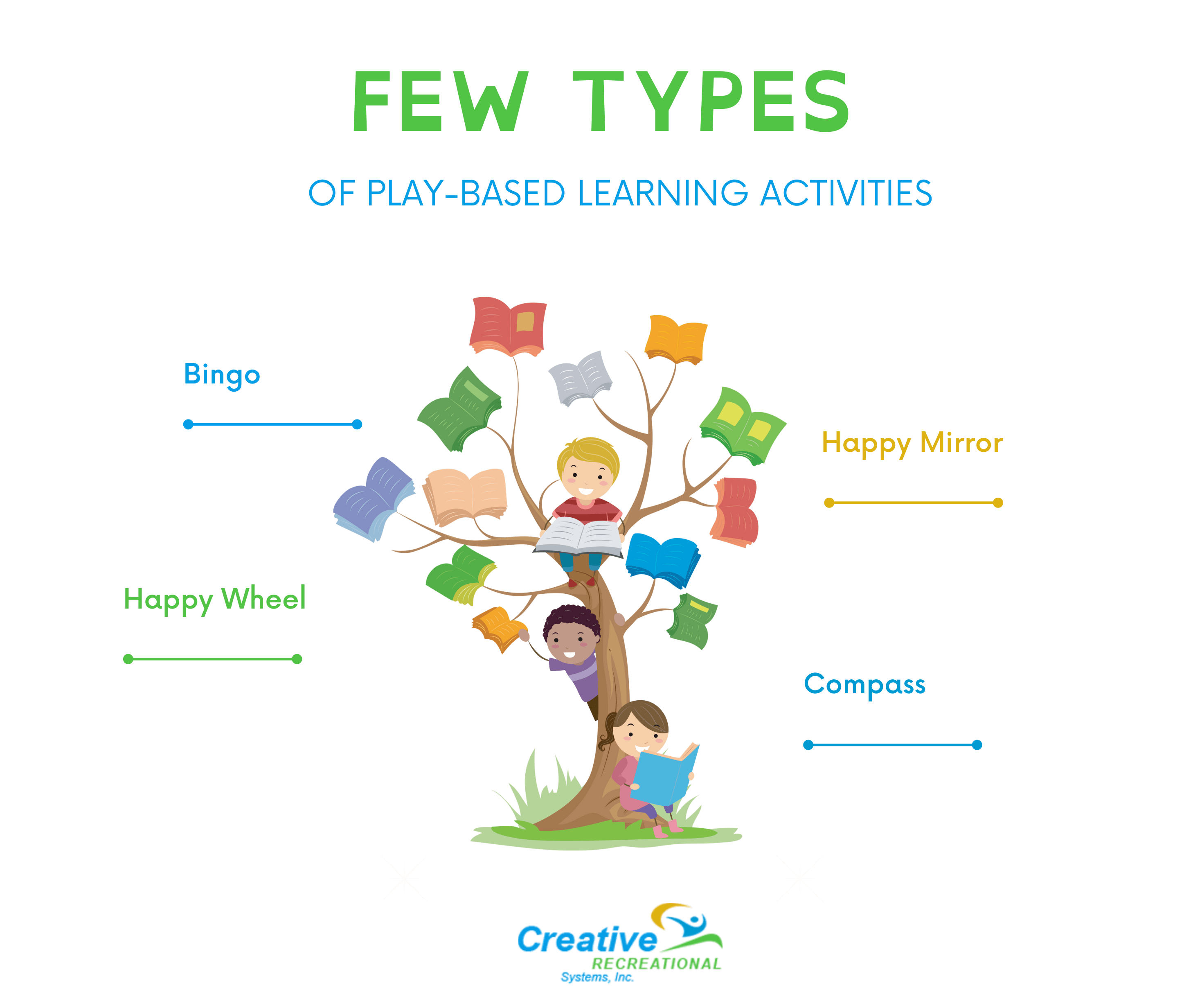
What Are A Few Types Of Play-Based Learning Activities?

Since we introduced you to play-based learning, we will not leave you hanging. So we have gathered a list of a few play-based learning activities you can engage your kids in. Using these activities randomly or at a specific interval can drive you even better results. Do not stop; experiment and figure out what fits your kid the best. You can find out about tens of other activities on the internet too. Now, let us share the details of some with you.

Bingo

Bingo is a flashcard activity primarily used for kids between 4 to 8 years of age, but it can be above this age too. It is a game of probability in which the players mark off random numbers written on the cue card one by one. The player who ticks off all the numbers first wins. This activity encourages perseverance in kids.

Happy Mirror

Children of 4 to 6 years love this game a lot; that helps kids learn and remember expressions. Here is how you play the happy mirror game.

  • Begin by holding a mirror up so that you and your child can see each other.
  • Make different facial expressions which can be happy, sad, angry, funny, and so on (it sounds so fun, but it is even more fun to play).
  • Once you are done, ask your child to copy your facial expressions.
  • Then ask them to name those expressions too.

Side note: You can also play in front of your dressing mirror if you do not have a separate mirror.

Happy Wheel

If you want your kids to learn endurance, this is a suitable game for them, especially if they are under six.

  • Get a wooden wheel made and make partitions in it.
  • Decorate the wooden wheel with various geometric shapes using different colors to make it presentable and attractive.
  • Make an arrow and attach it to the wheel.
  • Now, spin the wheel, and when the wheel stops, kids tell the shape’s name and the shape’s color that the arrow is pointing towards.

Compass

If your kids have outgrown the age limit of 6 years, you can seek help from this game called a compass. It is preferred for kids 8-10 years of age and helps them learn various parts of speech, including nouns, adjectives, etc. It is a fun activity to play if you have family members around. Here is how you play the compass game.

  • So basically, the compass game is to help your child build self-esteem and decision power.
  • You make a giant compass and ask the kid to take a certain number of steps in the direction the compass is pointing.
  • Say the compass is pointing towards the North; you say aloud, “4 steps to the North”. Now the kid decides where to move.
  • When playing this game, your kids will learn directions and their names, and get a hold of numbers too.

How Do I Implement Play-Based Learning?

If your kids are used to the traditional method of teaching or learning, it might take some time but trust us; kids can always enjoy playing. So sooner or later, you will get them to adjust to this method of training/learning that both you and they will enjoy. Let us give you a brief idea of how you can implement play-based learning at home or school.

  • Show kids how to play with toys appropriate for their development using modeled instructions. You can use toys or puzzles as well.
  • When choosing puzzles, choose the ones that require mathematical skills and those that allow unstructured playtime.
  • Interact with the kids. Ask questions and push them to ask questions popping into their minds too.
  • You can also leave the kids with a few things during the session.
  • When the session ends, ask kids what they learned today. Make them speak.

What Are The Pros Of Play-Based Learning?

Some benefits of play-based learning your kids can enjoy if you let them into play-based learning include:

  • Your kids will engage more with others. It is the perfect way to get introverted or shy kids to interact with others and increase their social circle.
  • Your kids will develop fine and gross motor skills, and thus, your kids will have improved physical skills too.
  • When working in a group, your kids will develop leadership skills as well as negotiation skills to work in a group.
  • Your kids will learn not to quit if they do not succeed in their goal once, which is one golden rule of life.

What Are The Cons Of Play-Based Learning?

Like every other thing, play-based learning has its downsides, too, so we wanted to give you a brief look into it. The decision will then be yours if you wish to opt for it.

  • Although play-based learning has many benefits for various age groups, people do not trust its usefulness for older students.
  • As kids grow, the versatility you can introduce to play-based learning decreases as the topics get complex.
  • Parents are reluctant to give too much play time to their kids as they believe it will lead to a lack of discipline.
  • Some also believe that the risks of injuries are higher in play-based activities.

How Are Parents Reacting To This Approach?

The biggest drawback of play-based learning is that people are reluctant to follow it. Parents think the play is just playing and has nothing to do with education. While many educational administrators also feel this learning method could be more reliable. Once play-based learning gets the recognition it deserves, we are optimistic it will do wonders in the history of teaching/learning. We hope this changes with time.

Our Final Thoughts

The focal point of today’s blog post is that play-based learning has proven to be a game-changing approach to kids learning. Studies conducted as a part of psychological research show that kids taught using play-based learning techniques learned better and quicker than those trained on the same topics using traditional approaches. It is high time parents realize that the times have changed, and so should the teaching methods. What are your thoughts on this? Let us know in the comments below.